
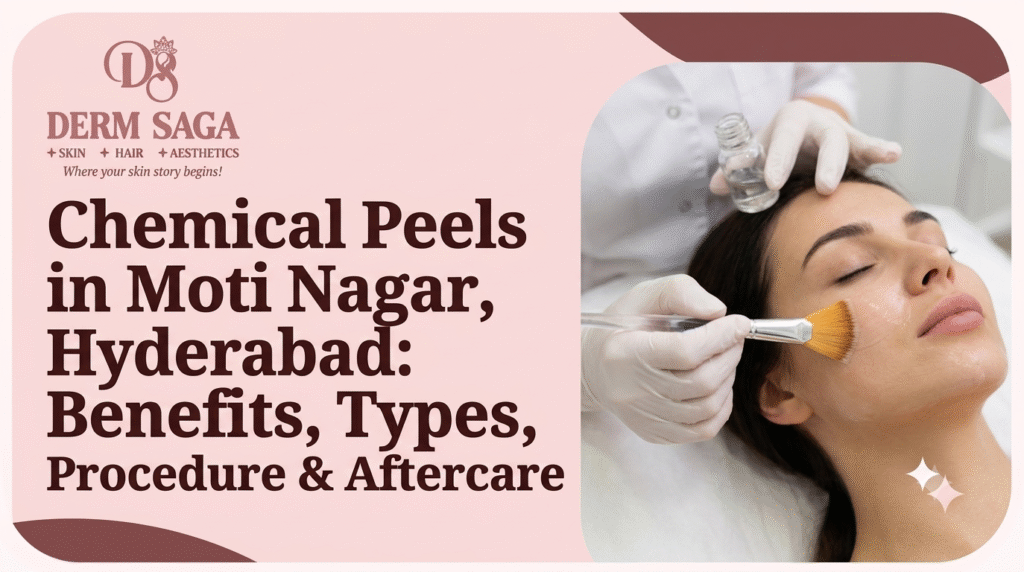
Chemical Peels in Moti Nagar, Hyderabad: Benefits, Types, Procedure & Aftercare
If you are dealing with acne, pigmentation, tanning, dull skin, uneven skin tone, or rough skin texture, you may have heard about chemical peels.
A chemical peel is a dermatologist-performed treatment that uses a carefully selected chemical solution to exfoliate the outer layers of the skin. Depending on the type and strength of the peel, it can help improve concerns such as acne, discoloration, dullness, fine lines, and uneven skin texture.
For people searching for chemical peels in Moti Nagar, Hyderabad, understanding the procedure and choosing the right peel for your skin is more important than simply choosing the strongest peel.
What Is a Chemical Peel?
A chemical peel is a professional skin treatment in which a dermatologist applies a chemical solution to the skin for a controlled period.
The treatment encourages the shedding of damaged or unwanted surface skin cells and promotes skin renewal.
Depending on the formulation and concentration, chemical peels can be used for concerns such as:
- Acne
- Acne marks
- Pigmentation
- Uneven skin tone
- Sun damage
- Dull complexion
- Rough skin texture
- Certain types of melasma
- Fine lines
The American Academy of Dermatology notes that chemical peels can improve skin smoothness, brightness, and evenness of skin color, while also being used for certain acne and discoloration concerns.
Benefits of Chemical Peels
1. Helps Improve Acne
Certain chemical peels can help remove dead skin cells and excess oil that contribute to clogged pores.
Chemical peels may therefore be included as part of a dermatologist-guided acne treatment plan.
2. Helps Reduce Pigmentation
Uneven pigmentation can develop because of sun exposure, acne inflammation, hormonal changes, and other factors.
Depending on the cause, a dermatologist may recommend a chemical peel as one component of a pigmentation treatment plan.
3. Improves Skin Texture
If your skin feels rough or looks uneven, appropriate chemical exfoliation can help improve its surface texture.
With a suitable peel and proper aftercare, skin may appear smoother and more refreshed.
4. Helps With Acne Marks
Chemical peels can be useful for some types of post-acne discoloration.
However, acne marks and acne scars are not the same thing. Depressed or indented scars often require other procedures, and dermatologists may combine treatments depending on the scar type.
5. Gives the Skin a More Even Appearance
Chemical peels can help improve uneven skin tone and dull-looking skin.
The exact result depends on the underlying skin concern, peel type, skin type, and treatment plan.
Types of Chemical Peels
Chemical peels aren’t a single treatment. They vary in strength and depth.
Superficial Peels
These work primarily on the outermost layers of the skin and are commonly used for concerns such as mild pigmentation, dullness, and some acne-related concerns.
They generally involve less downtime.
Medium-Depth Peels
These penetrate deeper and can be used for selected pigmentation, texture, and aging concerns.
They typically involve more recovery than superficial peels.
Deep Peels
These penetrate much deeper and require significantly more recovery and medical supervision.
The AAD notes that deep chemical peels require substantial recovery and should be performed in an appropriate medical setting.
Important: The strongest peel isn’t automatically the best peel. Your dermatologist should determine the appropriate type and strength based on your skin and concern.
What Happens During a Chemical Peel?
Before the procedure, your dermatologist evaluates your skin and discusses:
- Your primary concern
- Skin type
- Current skincare products
- Previous treatments
- Medications
- History of pigmentation or scarring
- Expected results
- Possible downtime
Your skin is then cleansed and prepared before the selected peel is applied.
During treatment, you may experience sensations such as warmth, tingling, or mild stinging depending on the peel.
The dermatologist monitors the skin and follows the appropriate protocol for the selected peel.
The AAD recommends discussing your medications, previous treatments, history of cold sores, and tendency to scar with your dermatologist before treatment.
Is There Downtime After a Chemical Peel?
Downtime depends on the depth and type of peel.
After a superficial peel, you may experience:
- Mild redness
- Dryness
- Tightness
- Scaling or peeling
Medium and deeper peels can involve more noticeable redness, peeling, and recovery.
According to the AAD, healing after a lighter peel can take around 1–7 days, while deeper treatments can require substantially longer recovery.
Chemical Peel Aftercare
After your treatment, following your dermatologist’s instructions is extremely important.
Use Sunscreen
Freshly treated skin needs careful sun protection.
Use the sunscreen recommended by your dermatologist and minimize unnecessary sun exposure.
Don’t Pick or Peel the Skin
If your skin starts peeling, don’t pull or scratch it.
Doing so can increase irritation and the risk of complications.
Follow Your Skincare Plan
Your dermatologist may temporarily ask you to stop certain active ingredients or exfoliating products.
Keep the Skin Moisturized
Use the recommended moisturizer to support the skin barrier during recovery.
The AAD specifically recommends following post-peel care instructions and using sunscreen after the skin has healed.
Are Chemical Peels Safe for Indian Skin?
Chemical peels can be performed safely on darker skin types, but the choice of peel, concentration, technique, and aftercare matter.
People with skin of color can have a higher risk of developing unwanted pigmentation after certain procedures if the treatment isn’t appropriately selected.
The AAD recommends seeing a dermatologist experienced in treating darker skin tones to reduce the risk of permanent pigment changes.
This is particularly relevant for patients in Hyderabad and other parts of India where pigmentation concerns are common.
Chemical Peel vs Laser Treatment
Chemical peels and lasers are different procedures.
| Chemical Peel | Laser Treatment |
|---|---|
| Uses a chemical solution | Uses controlled light/laser energy |
| Different depths are available | Different lasers target different concerns |
| Can help with acne and pigmentation | Can address selected pigmentation, scars, texture and other concerns |
| Downtime depends on peel depth | Downtime depends on laser and intensity |
| Usually requires multiple sessions for some concerns | Number of sessions depends on treatment and concern |
Your dermatologist may recommend a peel, laser treatment, or a combination depending on your skin condition.
laser toning treatment and CO2 laser treatment
Who Should Consider a Chemical Peel?
A dermatologist may consider chemical peels for people concerned about:
- Acne
- Acne marks
- Uneven skin tone
- Pigmentation
- Dull skin
- Sun damage
- Rough texture
- Certain fine lines
However, chemical peels aren’t appropriate for everyone or every skin concern.
A consultation helps determine whether a peel is suitable or whether another treatment would be more appropriate.
Why Choose Professional Chemical Peels in Moti Nagar, Hyderabad?
If you’re searching for chemical peels in Moti Nagar, Hyderabad, don’t choose a treatment solely based on price or the strength of the peel.
Look for:
- Dermatologist evaluation
- Proper diagnosis
- Appropriate peel selection
- Experience with your skin type
- Clear pre- and post-treatment instructions
- Appropriate follow-up
Derm Saga Skin & Hair Clinic is located in Kalyan Nagar, Moti Nagar, Hyderabad – 500114, and provides dermatology and skin-care services in the area.
Chemical Peels at Derm Saga
At Derm Saga, chemical peel treatment can be considered as part of a personalized plan for concerns such as acne, pigmentation, uneven skin tone, and skin texture.
Depending on your concern, a dermatologist may also consider other procedures or combine treatments.
For example:
Pigmentation → Chemical peel / laser-based treatment / medical skincare
Acne → Medical treatment / chemical peel / other dermatologist-guided procedures
Acne scars → Chemical peel / subcision / microneedling / laser depending on scar type
Skin rejuvenation → Chemical peel / skin boosters / other aesthetic treatments
You can explore related services on the Derm Saga website.
Frequently Asked Questions
How many chemical peel sessions are needed?
It depends on the skin concern and type of peel. Some superficial peels may require multiple sessions to achieve the desired improvement.
Can chemical peels remove pigmentation permanently?
No treatment can guarantee permanent removal of pigmentation. The underlying cause, sun exposure, hormones, and skincare habits can influence recurrence.
Can chemical peels treat acne scars?
They may help certain types of acne scarring, but deeper scars often require other procedures or a combination approach.
Can I do a chemical peel at home?
Professional-strength chemical peels should not be performed at home without appropriate medical supervision. The AAD notes that improperly used chemical peels can cause serious skin injuries.
Is peeling always necessary after a chemical peel?
Not necessarily. The amount of visible peeling depends on the type and depth of the treatment. A peel can still work even when dramatic peeling isn’t visible.

