
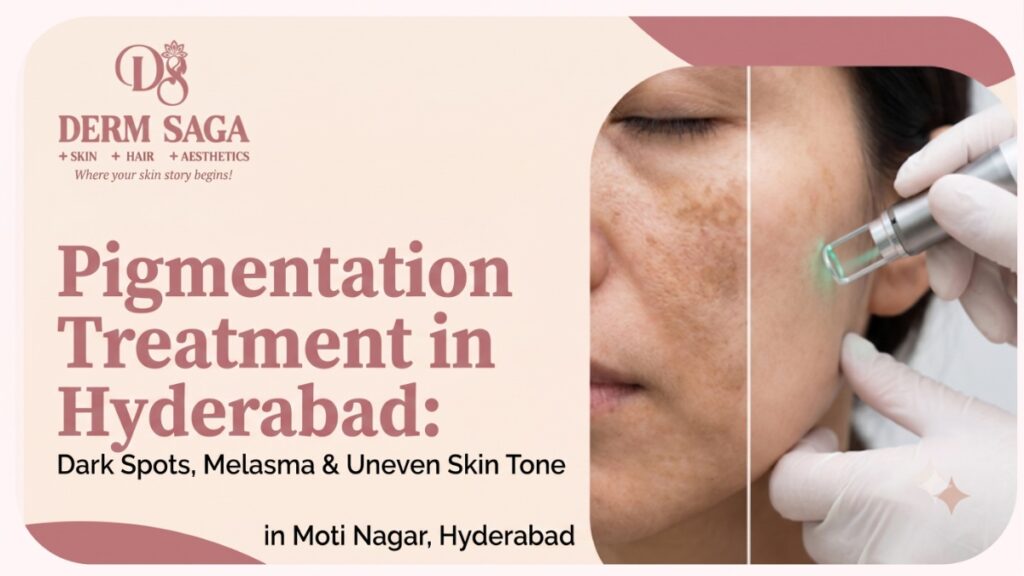
Pigmentation Treatment in Hyderabad: Dark Spots, Melasma & Uneven Skin Tone
Dark spots, melasma, tanning and uneven skin tone are some of the most common pigmentation concerns people experience. In Hyderabad, regular sun exposure, heat, hormonal changes, acne and skin inflammation can all contribute to pigmentation or make existing pigmentation more noticeable.
The good news is that pigmentation can often be improved with the right diagnosis, consistent sun protection and a dermatologist-guided treatment plan.
At Derm Saga Skin & Hair Clinic in Hyderabad, pigmentation treatment is personalised according to the type, cause, depth and sensitivity of the skin. Depending on the concern, treatment may include prescription skincare, chemical peels, laser-based procedures or a combination of approaches.
Looking for pigmentation treatment in Hyderabad? A dermatologist can first determine whether the pigmentation is melasma, post-acne pigmentation, sun-induced pigmentation, tanning or another condition before recommending treatment.
What Is Skin Pigmentation?
Skin pigmentation refers to the colour of the skin, which is primarily determined by melanin. Melanin is produced by specialised cells called melanocytes.
When melanin production or distribution increases in certain areas, darker patches or spots can appear. This is known as hyperpigmentation.
Pigmentation may appear as:
- Dark spots on the face
- Brown patches on the cheeks or forehead
- Pigmentation around the mouth
- Post-acne dark marks
- Sunspots
- Tanning
- Uneven skin tone
- Melasma
Not every dark patch has the same cause. That is why identifying the type of pigmentation is an important first step.
Common Types of Pigmentation
- Melasma
Melasma is a common pigmentation disorder that usually appears as symmetrical brown or grey-brown patches on areas such as the cheeks, forehead, nose and upper lip.
Sun exposure is an important trigger, while hormonal factors and other individual triggers can also contribute. Melasma can be persistent and may return even after it improves.
Because melasma can behave differently from other forms of pigmentation, aggressive treatment is not always the best approach.
- Post-Inflammatory Hyperpigmentation
Post-inflammatory hyperpigmentation, or PIH, can develop after inflammation or injury to the skin.
Common triggers include:
- Acne
- Pimples
- Skin irritation
- Insect bites
- Certain skin conditions
- Picking or scratching the skin
- Some cosmetic procedures
The original acne or inflammation may disappear, but the resulting dark mark can remain for months.
- Sunspots and Sun-Induced Pigmentation
Repeated UV exposure can stimulate melanin production and contribute to tanning, dark spots and uneven pigmentation.
Consistent sun protection is therefore an important part of pigmentation management, not just an additional skincare step. Dermatology guidance recommends broad-spectrum sunscreen, with tinted sunscreen containing iron oxide being particularly useful for pigmentation concerns because visible light can also worsen dark spots.
- Uneven Skin Tone
Uneven skin tone can result from a combination of tanning, post-acne marks, inflammation, dehydration, environmental exposure and other skin conditions.
Treatment depends on the underlying cause rather than simply trying to “brighten” the skin.
What Causes Pigmentation?
Pigmentation can have several causes, including:
Sun exposure
UV radiation stimulates melanin production. Repeated exposure can make existing pigmentation darker and contribute to new pigmentation.
Hormonal changes
Hormonal factors can play an important role in melasma. Pregnancy and certain medications, including some hormonal contraceptives, may contribute to melasma in susceptible individuals.
Acne and skin inflammation
Inflammation can leave behind dark marks after acne or other skin problems have healed.
Skin irritation
Harsh skincare products, over-exfoliation and irritating treatments may trigger inflammation and worsen pigmentation in some people.
Genetics and individual skin characteristics
Some people are more prone to developing pigmentation because of their skin type and individual susceptibility.
Why Is Pigmentation Commonly Difficult to Treat?
Pigmentation is not always located at the same depth within the skin.
Some pigmentation is predominantly superficial, while other pigmentation can extend deeper into the skin. Melasma, for example, can have epidermal, dermal or mixed components, and the response to treatment can vary accordingly.
This is one reason why a treatment that works well for one person may not be appropriate for another.
Trying multiple strong products without understanding the cause can also irritate the skin and potentially worsen post-inflammatory pigmentation.
Pigmentation Treatment in Hyderabad: What Are the Options?
There is no single pigmentation treatment that works for everyone.
A dermatologist may recommend one treatment or combine different approaches depending on the diagnosis.
- Prescription Skincare
Depending on the type of pigmentation, dermatologists may prescribe ingredients designed to reduce excess pigment production or improve skin cell turnover.
Examples can include:
- Hydroquinone
- Retinoids
- Azelaic acid
- Kojic acid
- Tranexamic acid
- Other dermatologist-selected pigment-reducing agents
Some prescription treatments require careful monitoring because irritation itself can contribute to pigmentation.
Do not start prescription pigment-lightening medication without professional guidance.
- Chemical Peels
Chemical peels use controlled exfoliation to improve certain types of pigmentation and uneven skin tone.
Depending on the skin condition, dermatologists may select different peel formulations and strengths.
Chemical peels may be considered for:
- Mild pigmentation
- Post-acne marks
- Sun damage
- Uneven skin tone
- Superficial pigmentation
DermSaga also provides [chemical peel treatments] as part of its dermatology and aesthetic services.
However, chemical peels need to be selected carefully, particularly for Indian skin tones, because excessive irritation can lead to post-inflammatory hyperpigmentation.
- Laser Toning and Pigmentation Laser Treatments
Laser-based treatments may be considered for selected pigmentation concerns that do not respond adequately to skincare alone.
DermSaga offers [laser toning treatment in Moti Nagar, Hyderabad] as one of its skin treatment options.
Laser treatment is not automatically the best option for every type of pigmentation. The wavelength, energy settings, treatment interval and diagnosis all matter.
In melasma, for example, lasers and other procedures need to be used cautiously because pigmentation can sometimes recur or worsen after procedures.
- Hydrafacial and Medi-Facials
Hydrafacial and medical facials may be useful as supportive treatments for skin that appears dull, dehydrated or uneven.
They can help with cleansing, exfoliation and hydration, but they should not be considered a universal treatment for conditions such as melasma.
DermSaga’s [Hydrafacial treatment] can be considered as part of a broader skin-maintenance plan when appropriate.
- Combination Treatment
Some pigmentation concerns respond better when different treatment approaches are combined.
For example, a dermatologist may recommend a combination of:
- Prescription skincare
- Sun protection
- Chemical peels
- Laser-based treatment
- Hydration and barrier-supportive skincare
- Maintenance treatment
The exact combination should depend on the diagnosis rather than following a fixed package.
Is Pigmentation Treatment Safe for Indian Skin?
Pigmentation treatment can be performed safely on Indian skin when the treatment is properly selected and performed by an experienced dermatologist.
However, darker or more pigment-prone skin can be more susceptible to post-inflammatory hyperpigmentation after irritation or injury.
This is why aggressive procedures are not necessarily better.
A personalised approach that considers skin type, pigmentation depth, current skincare, previous treatments and sun exposure can help reduce unnecessary irritation.
How Long Does Pigmentation Treatment Take?
The timeline depends on the cause and depth of pigmentation.
Some superficial dark marks may gradually improve over several weeks or months, while melasma can require longer-term management.
The American Academy of Dermatology notes that some dark spots may take 6–12 months to fade naturally, while deeper discoloration can take considerably longer. Treatment may accelerate improvement, but results vary between individuals.
Melasma can also be a chronic, relapsing condition, which means maintenance and prevention are often important even after improvement.
Does Sunscreen Really Help With Pigmentation?
Yes.
Sunscreen is one of the most important parts of pigmentation management.
UV exposure can stimulate melanin production and make pigmentation darker. Visible light can also contribute to hyperpigmentation, particularly in darker skin tones.
For people dealing with pigmentation, dermatologists commonly recommend:
- Broad-spectrum sunscreen
- SPF 30 or higher
- Regular reapplication when outdoors
- Protective clothing and shade
- Tinted sunscreen containing iron oxide when appropriate
The American Academy of Dermatology specifically recommends tinted sunscreen containing iron oxide for people concerned about dark spots because it can provide protection against visible light as well as UV exposure.
What Should Be Avoided When Treating Pigmentation?
Some common mistakes can make pigmentation worse.
Avoid aggressive scrubbing
Scrubbing does not remove deeper pigmentation and may irritate the skin.
Avoid DIY lemon or acidic remedies
Home remedies involving irritating acids can cause inflammation or burns and may leave darker marks.
Avoid unprescribed steroid or fairness creams
Some combination creams may contain potent medications that should only be used under medical supervision.
Avoid repeatedly changing treatments
Pigmentation usually takes time to improve. Frequently switching products can cause irritation and make it difficult to understand what is helping.
Avoid skipping sunscreen
Even an effective pigmentation treatment can produce disappointing results if ongoing UV and visible-light exposure are not controlled.
When Should You See a Dermatologist for Pigmentation?
Consider a dermatology consultation if:
- Dark patches keep returning
- Pigmentation is spreading
- Acne marks are not fading
- Pigmentation has appeared suddenly
- You have persistent melasma
- Home skincare has not helped
- Pigmentation worsens after using a product
- You are considering chemical peels or laser treatment
A dermatologist can determine whether the pigmentation is melasma, post-inflammatory hyperpigmentation, sun-related pigmentation or another condition before selecting treatment.
Why Choose Derm Saga for Pigmentation Treatment in Hyderabad?
Derm Saga Skin & Hair Clinic is located in Kalyan Nagar, near Moti Nagar, Hyderabad, and provides dermatology and aesthetic skin treatments. The clinic offers services including skin pigmentation treatment, chemical peels, Q-switched/YAG laser treatments, acne and acne-scar treatment and Hydrafacial/medi-facial treatments.
The clinic’s approach focuses on personalised assessment and treatment planning rather than using the same procedure for every pigmentation concern.
Derm Saga Skin & Hair Clinic
Kalyan Nagar, Near Moti Nagar, Hyderabad
For appointments: +91 93817 95495 / +91 83175 80815
Frequently Asked Questions
What is the best treatment for pigmentation in Hyderabad?
There is no single best treatment for every pigmentation condition. Treatment depends on whether the pigmentation is melasma, post-acne pigmentation, tanning, sunspots or another condition. A dermatologist may recommend skincare, chemical peels, laser treatment or a combination.
What is the best treatment for dark spots on the face?
The appropriate treatment depends on why the dark spots developed and how deeply the pigment is located. Post-acne marks, sunspots and melasma can require different treatment approaches.
Can melasma be completely removed?
Melasma can often be significantly improved, but it can recur. Long-term sun protection and maintenance treatment are often important.
How many sessions are needed for pigmentation treatment?
The number of sessions varies according to the type and severity of pigmentation and the treatment selected. Some people may improve with topical treatment alone, while others may require multiple supervised procedures.
Is laser treatment good for pigmentation?
Laser treatment can help selected pigmentation concerns, but it is not suitable for every case. Melasma, in particular, requires careful treatment because procedures can sometimes trigger recurrence or worsening.
Can pigmentation come back after treatment?
Yes. Pigmentation can recur, particularly melasma. Continued sun protection and a dermatologist-recommended maintenance plan can help reduce the risk of recurrence.
Can sunscreen reduce pigmentation?
Sunscreen can help prevent existing pigmentation from becoming darker and can support improvement as part of a broader treatment plan. Tinted sunscreen containing iron oxide may provide additional protection against visible light.
Pigmentation is not one single skin condition. Dark spots, melasma, tanning and post-acne pigmentation can look similar but may require very different treatment approaches.
The most effective approach is to first identify the cause, protect the skin from UV and visible light, avoid unnecessary irritation and use dermatologist-guided treatment when required.
If you are searching for pigmentation treatment in Hyderabad, a personalised consultation at Derm Saga Skin & Hair Clinic can help determine the most appropriate treatment plan for your skin.
Book a dermatology consultation with Derm Saga today.

